Partial Derivative Calculator: Find fx and fy Step by Step
The first time you see a function like f(x, y) = x²y³ + sin(xy), it looks like a big jump from normal calculus. Two variables? Curly ∂ symbols? It feels like a whole new subject.
It isn’t. If you can do ordinary derivatives, you already know 90% of partial derivatives. There’s just one new idea, and once it clicks the rest is the same rules you already use.
In this post I’ll explain that one idea, show you how to use a free partial derivative calculator to check your answers, and work through examples from easy to properly exam-style.
The one idea you need
A partial derivative measures how a function changes when you move one variable and freeze all the others.
That’s it. When you find the partial derivative with respect to x, you pretend y is just a number, like 5 or 7. When you go the other way, x becomes the number.
Here’s a picture that helps. Say a rectangle has width x and height y, so its area is A = xy. If you make it 1 cm wider but keep the height fixed, how much does the area grow? By y square centimetres. That’s ∂A/∂x = y. You changed x, held y still, and measured what happened.
The notation, quickly
You’ll see partial derivatives written a few ways, and they all mean the same thing:
- ∂f/∂x, or fₓ, or f_x: the partial derivative with respect to x
- ∂f/∂y, or fᵧ, or f_y: the partial derivative with respect to y
The curly ∂ (people say “partial” or “del”) just reminds you there are other variables you’re holding still.
How to use the partial derivative calculator
All Math Solver handles partial derivatives. No special page needed.
- Go to allmathsolver.com.
- Type the partial derivative using the ∂ symbol from the symbol keyboard, for example ∂/∂x (x²y³ + sin(xy)). You can also snap a photo of the question.
- Press Calculate.
The solver tells you which variable it’s differentiating with respect to, reminds you the others are treated as constants, and gives you the result. To get f_y as well, just run it again with ∂/∂y.
Example 1: A simple polynomial
f(x, y) = 3x²y + 5y³ − 7x
Finding fₓ. Treat y as a constant.
3x²y: the y is just a number sitting there, like the 3. Differentiate x² to get 2x, so this becomes 6xy.
5y³: there’s no x at all, so the whole thing is a constant. It becomes 0.
−7x becomes −7.
fₓ = 6xy − 7
Finding fᵧ. Now x is the constant.
3x²y: 3x² is the number in front, and y differentiates to 1. So this gives 3x².
5y³ becomes 15y².
−7x has no y, so it disappears.
fᵧ = 3x² + 15y²
That 5y³ vanishing in the first part is the bit that surprises people. But think about it: if y is frozen, 5y³ is frozen too. A frozen thing doesn’t change.
Example 2: With a chain rule inside
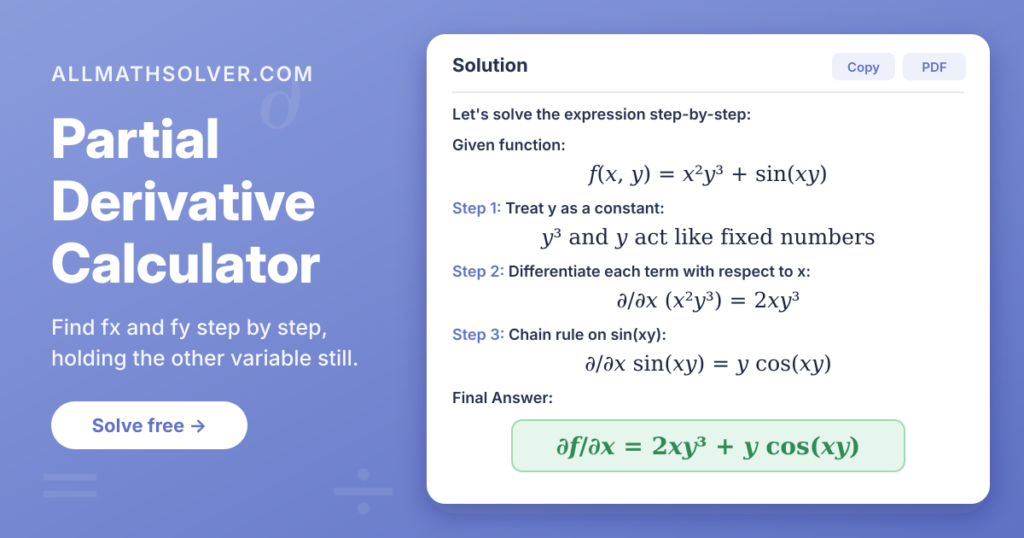
f(x, y) = x²y³ + sin(xy)
Finding fₓ.
x²y³: y³ is a constant, so this becomes 2xy³.
sin(xy): use the chain rule. The outside, sin, becomes cos(xy). Then multiply by the derivative of the inside, xy, with respect to x. Since y is a constant, that’s just y.
fₓ = 2xy³ + y cos(xy)
Finding fᵧ.
x²y³ becomes 3x²y².
sin(xy) becomes cos(xy) times x.
fᵧ = 3x²y² + x cos(xy)
If you’re rusty on the chain rule, our derivative calculator guide goes through it with examples.
Example 3: An exponential
f(x, y) = e^(xy)
e to anything differentiates to itself, times the derivative of the power.
With respect to x, the power xy differentiates to y. So fₓ = y·e^(xy).
With respect to y, it differentiates to x. So fᵧ = x·e^(xy).
Example 4: Three variables
Nothing changes with more variables. You just freeze more of them.
f(x, y, z) = x²yz + z³
fₓ: y and z are frozen. fₓ = 2xyz
fᵧ: x and z are frozen. fᵧ = x²z
f_z: x and y are frozen. f_z = x²y + 3z²
Second-order and mixed partial derivatives
Once you have fₓ and fᵧ, you can differentiate them again. Let’s go back to Example 1, where fₓ = 6xy − 7 and fᵧ = 3x² + 15y².
| Notation | How to get it | Answer |
|---|---|---|
| fₓₓ | Differentiate fₓ with respect to x | 6y |
| fᵧᵧ | Differentiate fᵧ with respect to y | 30y |
| fₓᵧ | Differentiate fₓ with respect to y | 6x |
| fᵧₓ | Differentiate fᵧ with respect to x | 6x |
Notice the last two came out the same? That’s not luck. For pretty much every function you’ll meet in school or uni, the mixed partials are equal. It’s called Clairaut’s theorem (or Schwarz’s theorem). It’s also a great free check: if your fₓᵧ and fᵧₓ don’t match, you’ve made a mistake somewhere.
Plugging in a point
Exam questions often ask for the value at a point. Just find the partial derivative first, then substitute.
Using Example 1, find fₓ at (1, 2). fₓ = 6xy − 7, so that’s 6(1)(2) − 7 = 5. In plain words: at that point, if you nudge x up a little while keeping y at 2, f rises about 5 times as fast.
Where partial derivatives are used
They show up anywhere something depends on more than one thing. In economics, they measure how profit changes when you change price but keep costs the same. In physics, how temperature changes along one direction in a room.But In machine learning, the gradient that trains a model is just a list of partial derivatives, one for each setting. And in multivariable calculus, setting fₓ = 0 and fᵧ = 0 together is how you find maximum and minimum points on a surface.
Mistakes to avoid
Forgetting that a term with no x vanishes in fₓ. 5y³ differentiates to 0 with respect to x, not 15y².
Differentiating the frozen variable. When you find fₓ of x²y³, the y³ stays exactly as it is.
Losing the chain rule factor. ∂/∂x of sin(xy) is y cos(xy), not just cos(xy).
Mixing up the order in mixed partials. fₓᵧ means x first, then y. Usually it doesn’t change the answer, but get the notation right anyway.
Questions people ask
What is a partial derivative in simple words? It’s how fast a function changes when you change one variable and keep all the others fixed.
How is it different from a normal derivative? A normal derivative is for functions of one variable. A partial derivative is for functions of two or more, and you differentiate with respect to one at a time.
Can the calculator do f_y as well as f_x? Yes. Run it once with ∂/∂x and once with ∂/∂y. It works the same way for z or any other variable.
Are f_xy and f_yx always the same? For the smooth functions you’ll meet in most courses, yes. That’s Clairaut’s theorem, and it’s a handy way to check your work.
Who needs partial derivatives? Anyone taking A-level further maths, multivariable calculus, engineering, physics, economics or data science.
Try one now
Pick Example 2, cover the answer, and work out fₓ and fᵧ yourself. Then put it into the free partial derivative calculator and check. If your answer is different, look at which variable you forgot to freeze. That’s almost always the culprit.