
Fractions LCM Calculator: How to Find the LCD (and the LCM of Fractions) Without the Headache
Adding 1/2 and 1/4 is easy. Most people can do it in their head. But ask someone to add 5/6 and 7/15 and you’ll often get a long pause, then a guess.
The problem isn’t adding. It’s finding a common denominator. And the quickest way to find one is the LCM, the least common multiple. That’s why so many students search for a fractions LCM calculator. They don’t want to list multiples of 15 for five minutes.
In this post I’ll show you exactly how the LCM fits into fraction problems, how to use the free LCM Calculator on All Math Solver to do the heavy lifting, and how to find the LCM of fractions, which is a slightly different question that trips people up.
Why fractions need the LCM in the first place
You can only add or subtract fractions when the bottoms match. 1/3 + 1/4 doesn’t work as it stands, because thirds and quarters are different sized pieces. It’s like adding 3 apples and 4 oranges.
So you rewrite both fractions so they’re cut into the same size pieces. That shared bottom number is the common denominator. You could use any common multiple, but the smallest one, the LCM, keeps the numbers small and saves you simplifying a giant fraction at the end. Teachers call it the lowest common denominator, or LCD. The LCD of two fractions is just the LCM of their denominators.
How to use the LCM calculator for fractions
One thing to know first. The calculator works with whole numbers, so you don’t type the fractions in. You type the denominators.
- Look at your fractions and write down just the bottom numbers. For 3/4 and 5/6, that’s 4 and 6.
- Open the LCM Calculator and type them in, separated by a comma or a space: 4, 6. You can enter up to 10 numbers at once, which is handy for long sums.
- Press Calculate. You’ll see each number broken into primes, the highest power of each prime picked out, and the LCM at the end. It even double-checks the answer using the GCF.
- Use that LCM as your new denominator.
If you’d rather throw the whole sum in, like 3/4 + 5/6, the main Math Solver handles fractions directly and shows the working.
Example 1: Adding two fractions
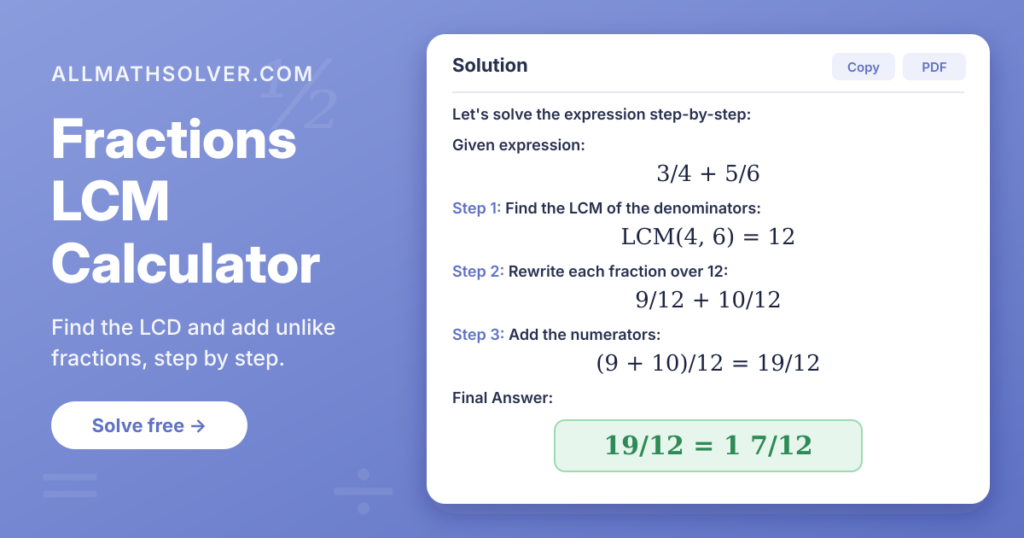
3/4 + 5/6
The denominators are 4 and 6. Their LCM is 12. (4 = 2² and 6 = 2 × 3, so the LCM is 2² × 3 = 12.)
Now change each fraction so it has 12 on the bottom. 4 goes into 12 three times, so multiply the top and bottom of 3/4 by 3. That gives 9/12. 6 goes into 12 twice, so 5/6 becomes 10/12.
Now it’s easy: 9/12 + 10/12 = 19/12, or 1 7/12 as a mixed number.
You might be thinking, why not just multiply 4 × 6 to get 24? You can. You’d get 18/24 + 20/24 = 38/24. But then you have to simplify 38/24 back down to 19/12. The LCM skips that extra step.
Example 2: Three fractions at once
1/6 + 3/8 + 5/12
This is where listing multiples gets painful, so let the prime factors do it.
6 = 2 × 3
8 = 2³
12 = 2² × 3
Take the highest power of each prime: 2³ and 3. Multiply them and the LCM is 24. Type 6, 8, 12 into the calculator and you’ll see the same thing.
Now convert. 1/6 = 4/24. 3/8 = 9/24. 5/12 = 10/24.
Add the tops: 4 + 9 + 10 = 23. Answer: 23/24.
Example 3: Which fraction is bigger?
The LCD isn’t only for adding. It’s also the cleanest way to compare.
Which is bigger, 5/8 or 7/12?
The LCM of 8 and 12 is 24. 5/8 becomes 15/24, and 7/12 becomes 14/24. Same size pieces now, so just compare the tops. 15 beats 14, so 5/8 is bigger. Only just, but it is.
Example 4: A real-life one
You’re baking and the recipe wants 1/3 cup of milk, then another 1/4 cup later on. How much milk do you need altogether?
The LCM of 3 and 4 is 12. 1/3 = 4/12 and 1/4 = 3/12. Together that’s 7/12 of a cup, a little over half.
Finding the LCM of fractions (a different question)
Sometimes a question asks for the LCM of the fractions themselves, not their denominators. This comes up in some school syllabuses, especially in CBSE and other South Asian boards. It means: what’s the smallest number that each fraction divides into a whole number of times?
There’s a neat formula for it:
LCM of fractions = LCM of the numerators ÷ HCF of the denominators
Make sure each fraction is in its simplest form first, or the answer comes out wrong.
Example: find the LCM of 2/3 and 4/9.
Numerators are 2 and 4. Their LCM is 4. Use the LCM Calculator for this part.
Denominators are 3 and 9. Their HCF is 3. The GCF / HCF Calculator does this part.
So the LCM is 4/3.
Does it work? 4/3 ÷ 2/3 = 2, a whole number. 4/3 ÷ 4/9 = 3, also a whole number. Yes.
And if you ever need the HCF of fractions, it’s the same idea flipped: HCF of the numerators ÷ LCM of the denominators.
Quick reference
| What you want | What to find | Which tool |
|---|---|---|
| Add or subtract fractions | LCM of the denominators (the LCD) | LCM Calculator |
| Compare fractions | LCM of the denominators | LCM Calculator |
| LCM of fractions | LCM of numerators ÷ HCF of denominators | LCM + GCF Calculators |
| HCF of fractions | HCF of numerators ÷ LCM of denominators | GCF + LCM Calculators |
| Full fraction sum with steps | Type the whole sum | Math Solver |
Mistakes to watch out for
Adding the bottoms. 1/3 + 1/4 is not 2/7. This is the classic one, and honestly, almost everyone does it once.
Changing the bottom but not the top. If you multiply the denominator by 3, the numerator gets multiplied by 3 too. Otherwise you’ve changed the value of the fraction.
Forgetting to simplify. If your answer is 10/12, the teacher wants 5/6.
Using the LCD formula for an “LCM of fractions” question, or the other way round. Read the question twice. “Add these fractions” and “find the LCM of these fractions” need different methods.
Questions people ask
What is the LCM used for in fractions? It gives you the lowest common denominator, so you can add, subtract or compare fractions with different bottom numbers using the smallest possible numbers.
Is the LCD the same as the LCM? The LCD of a set of fractions is the LCM of their denominators. So they’re the same number, just used in a fraction context.
Can I type fractions straight into the LCM Calculator? No, it takes whole numbers. Enter the denominators to get the LCD. To solve the whole fraction sum in one go, use the main Math Solver instead.
How do you find the LCM of fractions? Divide the LCM of the numerators by the HCF of the denominators. For 2/3 and 4/9, that’s 4 ÷ 3 = 4/3.
Can I just multiply the denominators instead? Yes, it always gives a common denominator. It just isn’t always the lowest one, so you’ll have more simplifying to do at the end.
Try it yourself
Next time you’re stuck on a fraction sum, don’t list multiples until your hand hurts. Pop the denominators into the free fractions LCM calculator, get the LCD in a second, and spend your time on the part that actually needs thinking.