Derivative Calculator With Steps: See How Every Answer Is Built
Differentiation is one of those topics that feels fine in class. The teacher does an example on the board, it all makes sense, you nod along. Then you sit down with the homework and the very first question has a product inside a chain inside a fraction, and suddenly nothing makes sense at all.
A good derivative calculator helps here, but only if it shows its working. An answer on its own tells you nothing. You need to see which rule was used, and where, and why.
That’s what this post is about. I’ll show you how to use the free solver on All Math Solver to differentiate a function step by step. Then we’ll go through every main rule with an example, so you can do them yourself too.
What a derivative actually tells you
Before the rules, one sentence on the idea, because it makes everything else easier.
A derivative is the rate of change. If y is how far a car has travelled, dy/dx is its speed. On a graph, the derivative at a point is the slope of the curve right there. Steep curve, big derivative. Flat curve, derivative of zero. That’s why you use derivatives to find maximum and minimum points: at the top of a hill, the slope is zero.
How to use the derivative calculator
There’s no separate page to hunt for. The main Math Solver on the home page handles derivatives, and shows product and chain rule steps.
- Go to allmathsolver.com.
- Type your question. Something like “find dy/dx if y = x² sin(3x)” or “differentiate (3x² + 1)^5” works. The symbol keyboard helps with powers, roots and trig functions.
- Or take a photo of the question in your book and upload that instead.
- Hit Calculate and read the steps. Each line says which rule was applied.
Sign in with Google or email if you want it to keep a history of what you’ve solved. Handy when you’re revising a week later and want to look back.
The derivative rules, with examples
The power rule
This is the one you’ll use most. Bring the power down to the front, then take one off the power.
d/dx (xⁿ) = n·xⁿ⁻¹
So x⁵ becomes 5x⁴. Easy.
With a whole polynomial, just do each term separately. Constants on their own disappear, because a flat number doesn’t change.
Example: y = 4x³ − 2x + 7
4x³ becomes 12x². The −2x becomes −2. The 7 vanishes.
dy/dx = 12x² − 2
The power rule also works for roots and fractions, once you rewrite them as powers. 1/x is x⁻¹, so its derivative is −x⁻², or −1/x². And √x is x^(1/2), which gives (1/2)x^(−1/2), or 1/(2√x).
The product rule
Use it when two functions are multiplied together.
If y = u·v, then dy/dx = u’v + uv’
In words: differentiate the first and leave the second alone, then add the first left alone times the second differentiated.
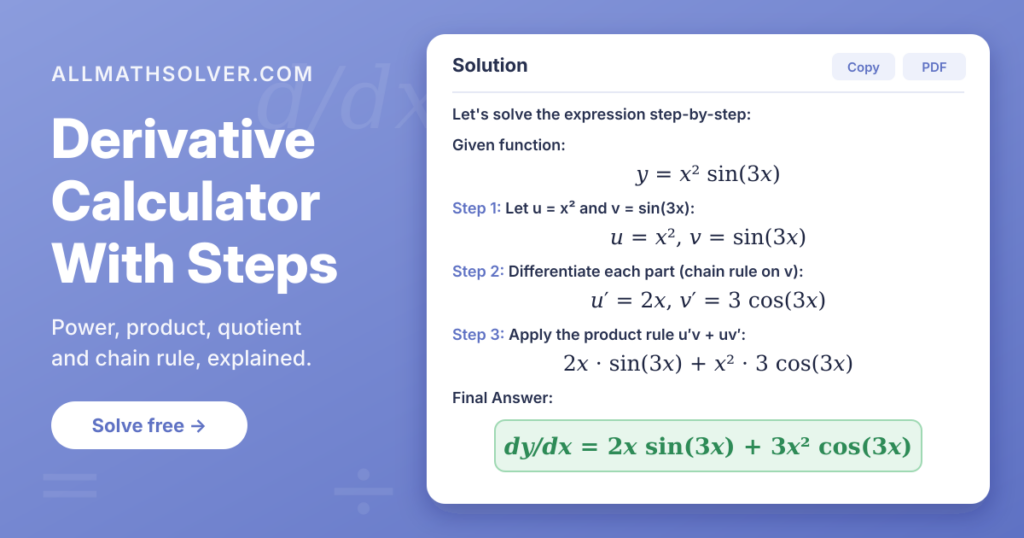
Example: y = x² sin(3x)
Let u = x², so u’ = 2x.
Let v = sin(3x), so v’ = 3cos(3x). (That 3 comes from the chain rule, more on that below.)
Put it together: dy/dx = 2x sin(3x) + 3x² cos(3x)
The quotient rule
For one function divided by another.
If y = u/v, then dy/dx = (u’v − uv’) / v²
The order on top matters here, because of the minus sign. A rhyme lots of teachers use is “low d-high minus high d-low, over the square of what’s below”.
Example: y = (x² + 1)/(x − 1)
u = x² + 1, so u’ = 2x. v = x − 1, so v’ = 1.
Top: (2x)(x − 1) − (x² + 1)(1) = 2x² − 2x − x² − 1 = x² − 2x − 1
dy/dx = (x² − 2x − 1)/(x − 1)²
The chain rule
This is the one people find hardest, and it’s also the one that shows up everywhere. Use it when there’s a function inside another function.
Differentiate the outside, keep the inside the same, then multiply by the derivative of the inside.
Example: y = (3x² + 1)⁵
The outside is “something to the power 5”. Differentiating that gives 5(3x² + 1)⁴.
The inside is 3x² + 1. Its derivative is 6x.
Multiply: 5(3x² + 1)⁴ · 6x
dy/dx = 30x(3x² + 1)⁴
Please don’t expand the bracket to the power of 5 first. You can, but it takes forever and you’ll probably make a mistake on the way.
Exponentials and logs
eˣ differentiates to itself. With anything else in the power, use the chain rule: d/dx e^(2x) = 2e^(2x).
ln x differentiates to 1/x. With a chain inside, you get the derivative of the inside over the inside. So d/dx ln(x² + 1) = 2x/(x² + 1).
Standard derivatives cheat sheet
| Function | Derivative |
|---|---|
| k (a constant) | 0 |
| xⁿ | n·xⁿ⁻¹ |
| eˣ | eˣ |
| aˣ | aˣ ln a |
| ln x | 1/x |
| sin x | cos x |
| cos x | −sin x |
| tan x | sec²x |
| u·v | u’v + uv’ |
| u/v | (u’v − uv’)/v² |
| f(g(x)) | f'(g(x))·g'(x) |
Putting it to use: finding a slope
Here’s a typical exam question. Find the gradient of y = x³ − 3x at the point where x = 2.
Differentiate first: dy/dx = 3x² − 3.
Then put x = 2 in: 3(4) − 3 = 9. So the curve is climbing with a slope of 9 at that point.
Want the turning points instead? Set the derivative to zero. 3x² − 3 = 0 gives x = 1 or x = −1.
Mistakes that cost marks
Forgetting the chain rule. sin(3x) does not differentiate to cos(3x). It’s 3cos(3x). This is probably the most common error in all of calculus.
Mixing up the quotient rule order. If you write uv’ − u’v on top, your answer has the wrong sign.
Treating a product like a sum. The derivative of x² sin x is not 2x cos x. You need the product rule.
The cos sign. cos x differentiates to −sin x. Keep the minus.
Not simplifying. Most teachers want the final answer tidied up, so factor out common terms where you can.
Questions people ask
Is the derivative calculator free? Yes. All Math Solver is free, with no sign-up needed. Signing in only saves your history.
Does it show the steps? Yes. It shows which rule is used at each stage, including the product and chain rule, not just the final answer.
Can it do second derivatives? Ask it for the derivative, then put that answer back in and differentiate again. The second derivative is just the derivative of the derivative.
What’s the difference between a derivative and an integral? They’re opposites. A derivative finds the rate of change. An integral works backwards to find the original function, or the area under a curve. Our post on integration rules covers that side.
What level is this for? Anything from GCSE further maths and A-level to AP Calculus, CBSE, JEE and first-year university.
Your turn
Differentiation clicks once you’ve done enough of it. Try a question yourself, then put it into the free derivative calculator and compare your working line by line. Wherever your steps don’t match, that’s exactly the bit to practise.